Managing AI Risk in Production: Lessons from Operating Healthcare Systems Across Four Countries
The Risk Management Reality Check
Most AI risk management frameworks look impressive on paper. Comprehensive matrices. Sophisticated taxonomies. Multi-layered governance structures. Then you try to deploy an AI diagnostic tool across Ghana, Nigeria, Kenya, and Egypt simultaneously—each with different data protection laws, varying infrastructure reliability, inconsistent data quality, and populations underrepresented in your training data. Reality hits hard.
As CTO of CarePoint, I was responsible for healthcare systems operating across four African countries. I didn’t have the luxury of theoretical risk management. I had to manage actual AI risks affecting real patients, navigate four different regulatory regimes, and build systems that worked despite infrastructure challenges that Western frameworks never anticipated.
Here’s what I learned: AI risk management isn’t about perfect frameworks. It’s about identifying what can actually go wrong in your specific context, implementing controls that work with your constraints, and monitoring continuously because AI systems don’t stay static.
The vendors who demoed their “comprehensive AI risk solutions” to me had never deployed AI in environments where:
- Internet connectivity is intermittent
- Four different regulators have four different interpretations of “automated decision-making”
- Your ML model might drift within weeks because population demographics shift faster than retraining cycles
This pillar is about real AI risk management—the kind you need when you’re actually responsible for AI systems in production, not just presenting to a board.
Why AI Risk Management Is Different
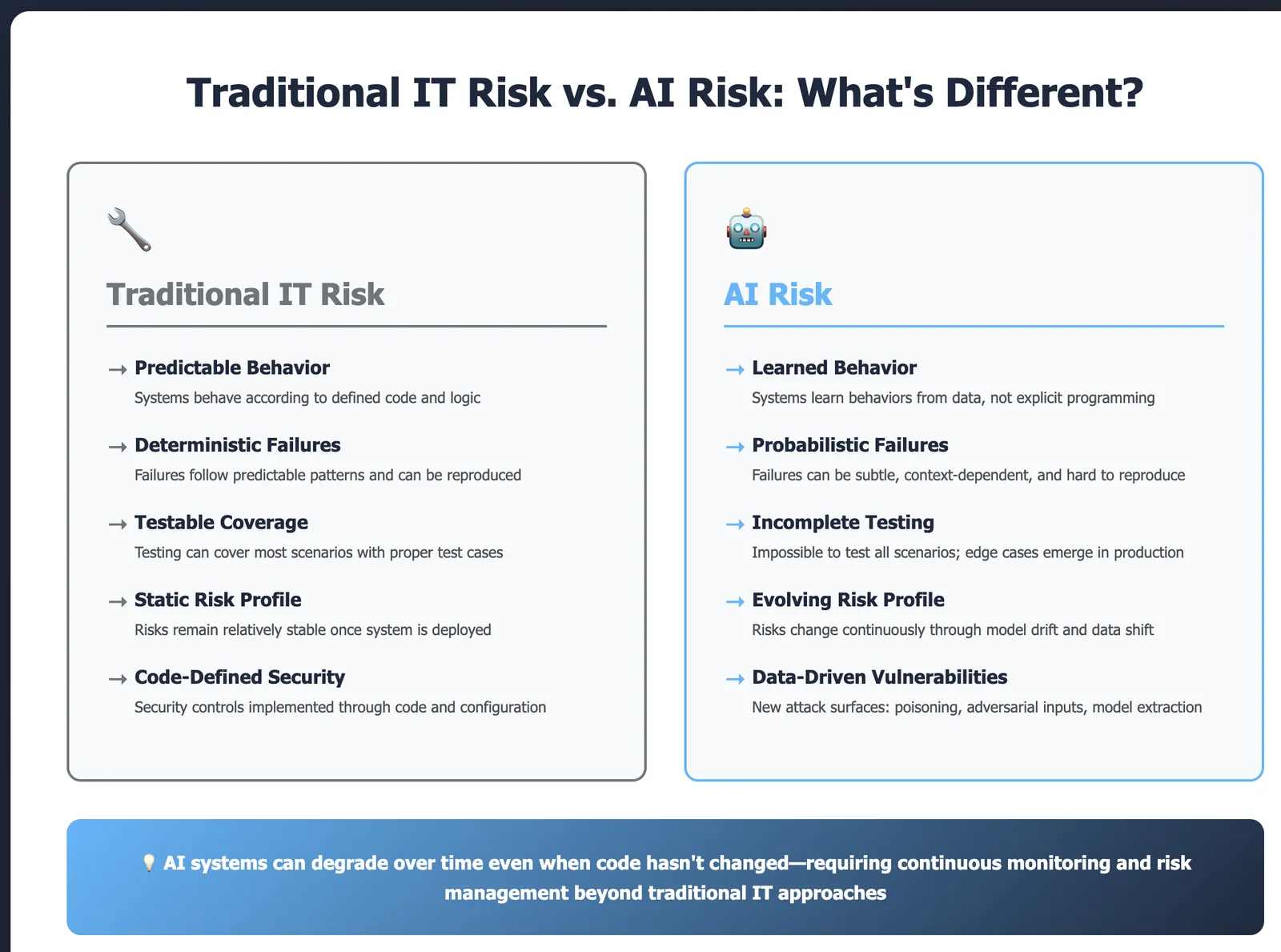
Traditional IT Risk vs. AI Risk
I hold the CISA certification. I understand traditional IT risk management. But AI introduces fundamentally different risk categories that caught me off guard as CTO:
Traditional Risk Model:
- Systems behave predictably from defined code
- Failures are usually deterministic
- Testing can cover most scenarios
- Risks are relatively static once deployed
AI Risk Model:
I. Systems learn behaviours from data
- Failures can be probabilistic and subtle
- Testing can’t cover all possibilities
- Risks evolve continuously (model drift, distribution shift)

The Four Risk Categories I Actually Managed
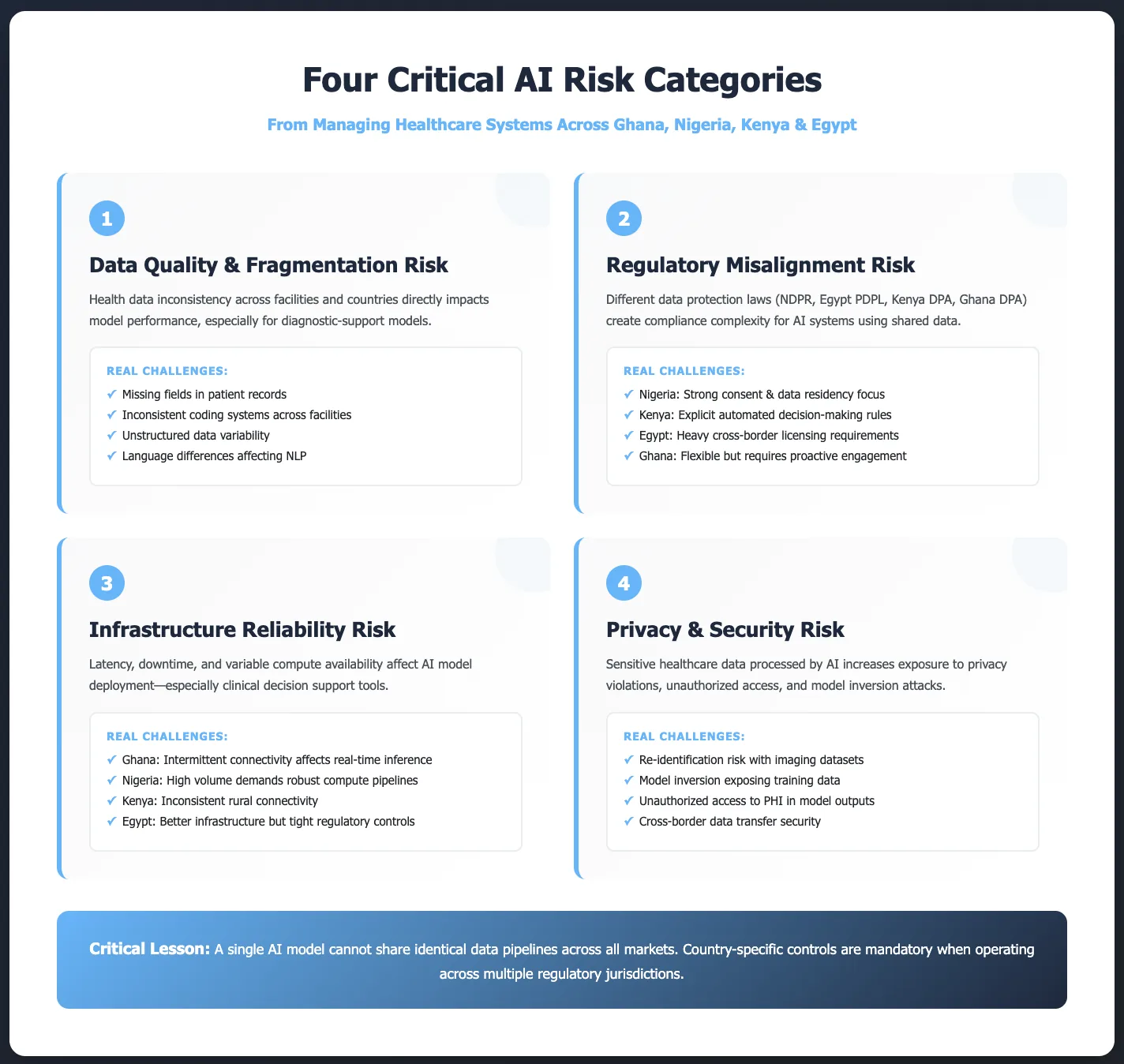
Through operating AI healthcare systems across four countries, I encountered AI risks that fell into four main categories:
- Data Quality & Fragmentation Risk. The Problem:
Health data was inconsistent across facilities and countries. Poor data quality directly impacted model performance, especially for diagnostic-support models. What This Looked Like:
- Missing fields in patient records
- Inconsistent coding systems across facilities
- Unstructured data variability (doctors’ notes in different formats)
- Language differences affecting natural language processing
The Impact:
Data quality issues weren’t just technical problems—they directly affected model accuracy, which affected clinical decisions.
How I Managed It:
- Implemented data quality scoring before training
- Built data validation pipelines with human review for critical datasets
- Established minimum data quality thresholds for model deployment
- Created country-specific data preprocessing workflows
2. Regulatory Misalignment Risk
The Problem:
Each country had different data protection laws creating compliance complexity for AI systems using shared or aggregated data:
- Nigeria (NDPR): Strong focus on consent, data residency, and auditability
- Kenya (Data Protection Act): Explicit guidance on data processors and automated decision-making
- Egypt (PDPL): Heavy licensing and approval requirements for cross-border transfers
- Ghana (DPA): More flexible but required proactive engagement to avoid ambiguity
What This Meant:A single AI model couldn’t share identical data pipelines across all markets. Compliance in Nigeria looked different from compliance in Egypt. Real Incident:
During a cross-border data review for Egypt, we discovered a regulatory compliance gap in how we were processing certain clinical metadata. It required re-engineering our entire data processing pipeline for that market.
How I Managed It:
- Built country-specific data controls
- Implemented geo-fenced data storage
- Created regulatory mapping documents for each jurisdiction
- Established local compliance review processes before deployment
3. Infrastructure Reliability Risk
The Problem:
Latency, downtime, and variable compute availability affected AI model deployment—especially clinical decision support tools.
Country-Specific Challenges:
- Ghana: Stable but with intermittent connectivity affecting real-time inference
- Nigeria: High patient volume created scaling risk and demanded robust compute pipelines
- Kenya: Stronger digital health adoption but inconsistent rural connectivity
- Egypt: Better infrastructure but tighter regulatory controls
Real Incident:
We underestimated third-party API dependency risks. When one cloud provider had an outage, it cascaded into delayed clinical reporting across multiple facilities. How I Managed It:
- Implemented offline-capable AI models for critical functions
- Built redundancy for essential inference services
- Created fallback workflows when AI systems were unavailable
- Monitored infrastructure dependencies as part of risk assessment
4. Privacy & Security Risk
The Problem:
Sensitive healthcare data processed by AI increased exposure to privacy violations, unauthorised access, and model inversion risk. Specific Concerns:
- Re-identification risk with imaging datasets
- Model inversion attacks potentially exposing training data
- Unauthorized access to model outputs containing PHICross-border data transfer security
Real Incident:A vendor-provided de-identification engine failed to remove certain quasi-identifiers from a dataset we were preparing for model training. We caught it during our internal review, but it highlighted that vendor promises don’t equal vendor performance. How I Managed It:
- Differential privacy techniques for data anonymization
- Strict separation of PII from model training datasets
- Encryption at rest and in transit
- Data minimization policies
- Zero-trust access to training pipelines
- Internal multi-layer anonymization (after vendor tool failed)
The Risk That Surprised Me: Bias and Fairness
I expected traditional security risks. I planned for compliance complexity. What caught me less prepared was bias and fairness risks when deploying AI models across diverse African populations.
Real Example: Skin Condition Classifier
We tested a dermatology AI model for BlackSkinAcne.com. The model performed significantly worse for darker skin tones. Why? The training dataset was Eurocentric—predominantly lighter skin tones. The model had learned patterns that didn’t generalize to African populations.
This wasn’t just a technical failure. It was an equity and patient safety issue.
Real Example: Diabetes Risk Prediction
A diabetes risk prediction model overestimated risk in one region due to data skew between urban and rural populations. The model had learned patterns from predominantly urban patients and wasn’t calibrated for rural health indicators.
How I Address Bias Risk Now:
- Dataset Representation Audits
- Verify training data represents actual patient populations
- Actively seek African-representative datasets
- Document demographic composition of training data
- Fairness Metrics During Evaluation
- Test model performance across population subgroups
- Measure fairness metrics (equal opportunity, demographic parity)
- Establish fairness thresholds before deployment
- Post-Deployment Bias Monitoring
- Continuous monitoring of model performance by demographic groups
- Quarterly fairness audits
- Clinical validation with local specialists
- Retraining and Recalibration
- Expand datasets when bias is detected
- Recalibrate decision thresholds for specific populations
- Retrain models with representative data
My Hybrid Risk Management Framework
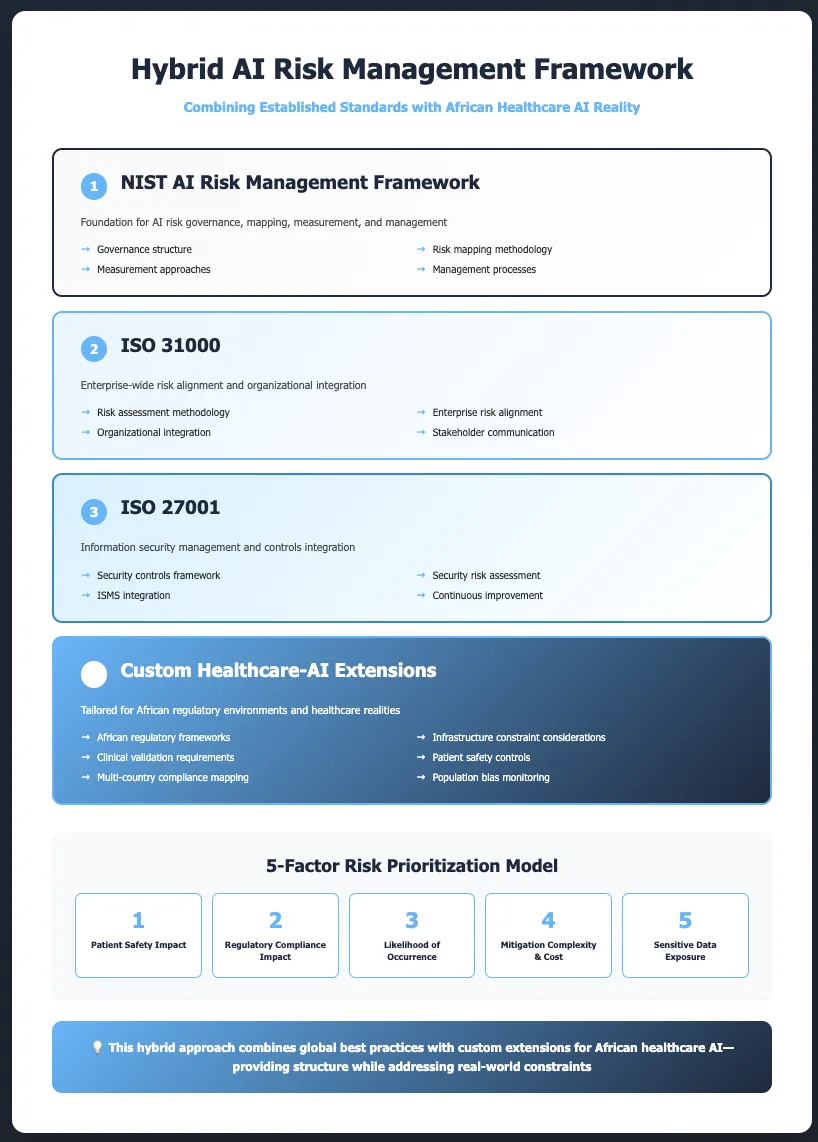
After managing AI risk across four countries, I developed a hybrid approach combining established frameworks with custom extensions for healthcare AI in African markets:
Foundation Frameworks:
NIST AI Risk Management Framework
- Governance structure
- Risk mapping methodology
- Measurement approaches
- Management processes
ISO 31000
- Enterprise-wide risk alignment
- Risk assessment methodology
- Integration with broader organisational risk
ISO 27001
- Information security controls
- Security risk assessment
- ISMS integration
Custom Healthcare—AI Extension
- African regulatory realities
- Infrastructure constraint considerations
- Clinical validation requirements
- Patient safety controls
How I Prioritize AI Risks:
Not all AI risks are equal. I use five factors to prioritize:
- Impact on Patient Safety (Highest priority)
- Impact on Regulatory Compliance
- Likelihood of Occurrence
- Complexity and Cost of Mitigation
- Exposure to Sensitive Data
This produces a High/Medium/Low classification with documented control requirements for each risk level.
Example:
- Model accuracy drift in diagnostic AI = HIGH (patient safety + high likelihood)
- Vendor API latency = MEDIUM (operational impact + moderate likelihood)
- Cosmetic UI rendering issue = LOW (no patient safety impact)
Continuous Risk Monitoring: Because AI Doesn’t Stay Static
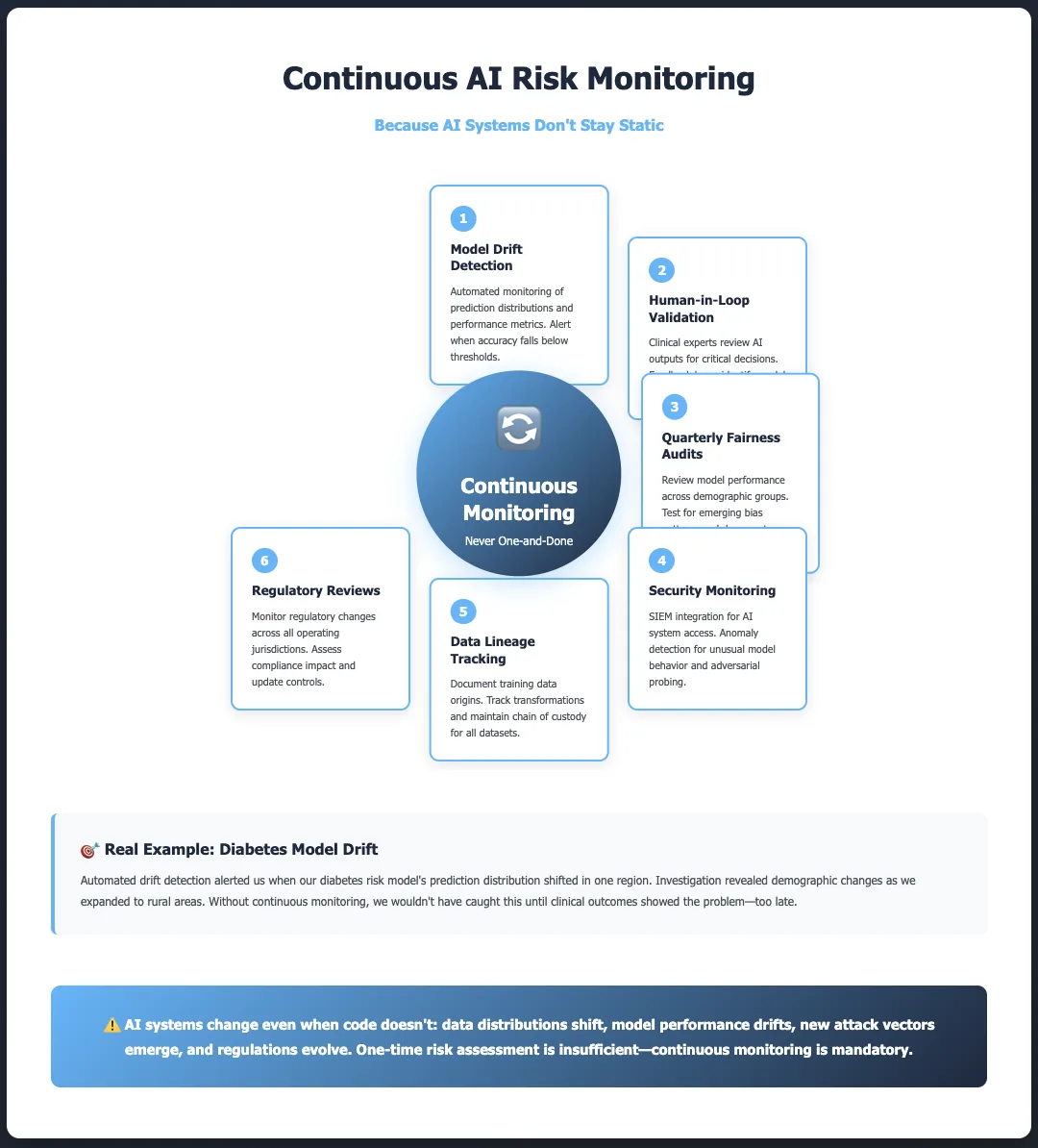
The biggest lesson from managing production AI systems: Risk assessment isn’t a one-time activity.
AI systems change even when code doesn’t:
- Data distributions shift
- Model performance drifts
- New attack vectors emerge
- Regulatory requirements evolve
My Continuous Monitoring Approach:
1. Automated Model Drift Detection
- Monitor prediction distribution changes
- Track model performance metrics over time
- Alert when accuracy falls below thresholds
2. Human-in-the-Loop Validation
- Clinical experts review AI outputs for critical decisions
- Feedback loops to identify model failures
- Regular clinical validation studies
3. Quarterly Fairness Audits
- Review model performance across demographic groups
- Test for emerging bias patterns
- Document fairness metrics trends
4. Continuous Security Monitoring
- SIEM integration for AI system access
- Anomaly detection for unusual model behaviour
- Monitoring for adversarial probing patterns
5. Data Lineage and Provenance Tracking
- Document where training data originated
- Track data transformations and preprocessing
- Maintain chain of custody for datasets
6. Regular Regulatory Mapping Reviews
- Monitor regulatory changes in all operating jurisdictions
- Assess compliance impact of new regulations
- Update controls as requirements evolve
Real Example:
We were far advanced in implementing automated drift detection for AI models in our SIEM application that would alert us when our diabetes risk model’s prediction distribution shifted in one region. The investigation revealed the demographic change I mentioned earlier. Without continuous monitoring, we wouldn’t have caught it until clinical outcomes showed the problem—too late.
Balancing Innovation and Risk Mitigation
As CTO, I had to enable innovation while ensuring patient safety and compliance. The tension is real. Move too slowly, and you can’t compete or deliver value. Move too fast, and you deploy unsafe systems or violate regulations.
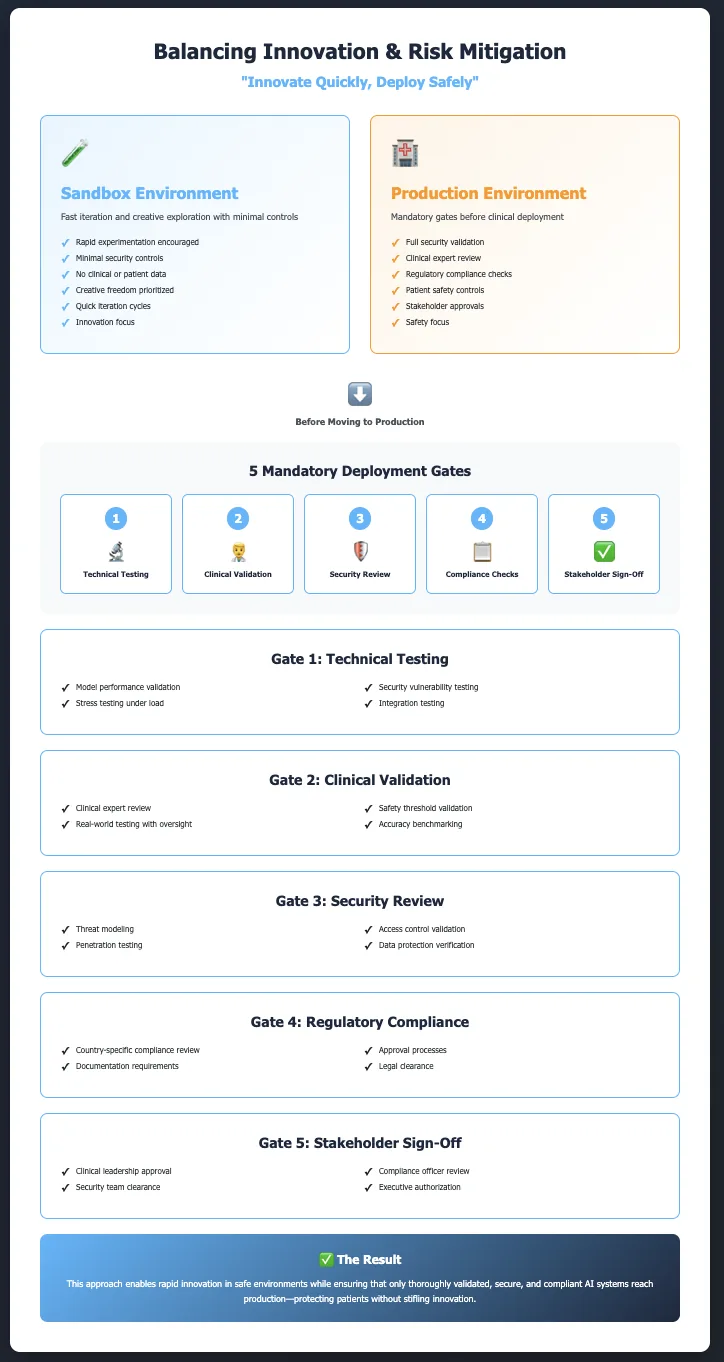
My principle: “Innovate Quickly, Deploy Safely.”
For Experimentation (Sandbox Environment):
- Fast iteration
- Minimal controls
- Encourage creative exploration
- No clinical or patient data
For Clinical Deployment (Production Environment):Mandatory gates before deployment:
a) Technical Testing
- Model performance validation
- Stress testing
- Security testing
b) Clinical Validation
- Clinical expert review
- Real-world testing with human oversight
- Safety threshold validation
c) Security Review
- Threat modeling
- Penetration testing
- Access control validation
d) Regulatory Compliance Checks
- Country-specific compliance review
- Documentation requirements
- Approval processes
e) Stakeholder Sign-Off
- Clinical leadership approval
- Security team clearance
- Compliance officer review
This enables innovation without compromising patient safety or compliance.
Mistake #1: Underestimating Model Drift
Mistake #1:
What Happened:
Initially, I assumed periodic retraining (quarterly) was sufficient. I was wrong. Model performance degraded noticeably in some regions within weeks. Lesson: Continuous monitoring is mandatory. Retraining schedules should be data-driven, not calendar-driven. What Changed: Implemented automated drift detection with thresholds that trigger retraining workflows.
Mistake #2: Trusting Vendor De-Identification
Mistake #2: What Happened:A vendor-provided de-identification tool failed to remove certain quasi-identifiers from a dataset. We discovered it during our internal review, not through the vendor’s quality assurance. Lesson:
Vendor promises don’t equal vendor performance. Trust but verify. What Changed:
Built an internal multi-layer anonymisation process. Vendor tools are now validated against our own testing before trusting them with sensitive data.
Mistake #3: Missing Third-Party Dependency Risks
Mistake #3:
What Happened:
During risk assessment, I focused on our own systems but underestimated third-party API dependency risks. When a cloud provider had an outage, it cascaded into delayed clinical reporting. Lesson:
Your risk surface includes everything your AI system depends on—internal and external. What Changed:
Now map all dependencies (APIs, cloud services, data sources) and assess their risks separately. Implement redundancy for critical dependencies.
Mistake #4: Accepting Vendor Explainability Claims
Mistake #4: What Happened:A vendor overstated the explainability of their model. During evaluation, it became clear the system was a black box with minimal transparency into decision-making. Lesson:
Demand proof, not promises. Model cards, documentation, and audit access before adoption. What Changed:
Established vendor evaluation criteria requiring:
- Model cards with architecture details
- Explainability demonstrations
- Access to model documentation
- Audit trail capabilities
- Representative dataset disclosure
Common AI Risks Vendors Miss
Through reviewing AI systems and evaluating vendor solutions, I see risks that vendors consistently underestimate or ignore:
- Population Representativeness Risk. The Problem:
Vendors train models on datasets that don’t represent African populations, then sell these models to African healthcare providers. The Risk:
Poor performance on darker skin tones, different disease presentations, and different health indicators. What to Ask Vendors:
-
“What’s the demographic composition of your training data?”
-
“Have you validated model performance on African populations?”
-
“Can you provide fairness metrics for different demographic groups?”
-
Infrastructure Assumption Risk. The Problem:
Vendors assume reliable high-speed internet, consistent power, and abundant compute resources. The Risk:
Solutions that work in Silicon Valley fail in African healthcare facilities with intermittent connectivity. What to Ask Vendors:
-
“How does your solution handle offline scenarios?”
-
“What are bandwidth requirements for inference?”
-
“Can the model run on edge devices with limited compute?”
-
Regulatory Localization Risk. The Problem:
Vendors build for GDPR or HIPAA without understanding local African regulations. The Risk:
Compliance gaps, inability to meet local data residency requirements, unclear legal responsibilities.
What to Ask Vendors:
- “Have you mapped your solution to [specific country] data protection law?”
- “Can you support data residency requirements?”
- “Do you understand your role as data processor under local law?”
Risk Management for Different AI Use Cases
AI risk profiles vary dramatically based on use case:
High-Risk: Clinical Decision Support
Risk Profile:
- Patient safety directly affected
- Regulatory scrutiny highest
- Liability exposure significant
- Errors have severe consequences
Required Controls:
- Extensive clinical validation
- Human-in-the-loop mandatory
- Continuous performance monitoring
- Explainability requirements
- Stringent data privacy controls
- Regular bias audits
Medium-Risk: Administrative AI
Risk Profile: Operational efficiency focusModerate regulatory requirementsPrivacy concerns present but lower stakesErrors are correctable Required Controls: Standard security controlsPrivacy impact assessmentsRegular performance monitoringData minimizationExplainability for auditing
Lower-Risk: Patient Education AI
Risk Profile: General information provisionLower regulatory requirementsMinimal patient safety impactContent accuracy important but not life-critical Required Controls: Content accuracy validationBasic security controlsPrivacy for any collected dataDisclaimer that AI doesn’t replace medical advice
Getting Started with AI Risk Management
For Organisations New to AI Risk Management
Step 1: Inventory Your AI Systems
- Document all AI/ML systems in use or development
- Classify by risk level (high/medium/low)
- Identify data sources and dependencies
Step 2: Conduct Initial Risk Assessment
- Use NIST AI RMF or similar framework
- Focus on your highest-risk systems first
- Document identified risks and existing controls
Step 3: Implement Foundational Controls
- Data quality validation
- Basic security controls (encryption, access management)
- Model performance monitoring
- Documentation requirements
Step 4: Establish Governance
- Define roles and responsibilities
- Create approval processes for AI deployment
- Establish review cycles
- Build compliance review workflows
Step 5: Monitor and Iterate
- Implement continuous monitoring
- Schedule regular risk reviews
- Update controls as needed
- Learn from incidents