Key takeaways
- AI risk management addresses unique threats that traditional IT security frameworks don't fully cover, including bias, explainability gaps, and model reliability issues
- Effective programs integrate technical controls, governance processes, and continuous monitoring across the AI system lifecycle
- Organizations face growing regulatory pressure through frameworks like the EU AI Act, NIST AI RMF, and industry-specific requirements
- Implementation requires cross-functional collaboration between data science, security, compliance, legal, and business teams
Organisations racing to adopt artificial intelligence are discovering that innovation without guardrails creates more problems than it solves. AI risk management is the systematic process of identifying, assessing, mitigating, and monitoring risks that emerge when organisations develop, deploy, or use artificial intelligence systems. Unlike traditional IT risk management, AI introduces unique challenges, including algorithmic bias, model drift, explainability requirements, and rapidly evolving regulatory obligations that demand specialised governance frameworks.
Understanding AI Risk Management Fundamentals
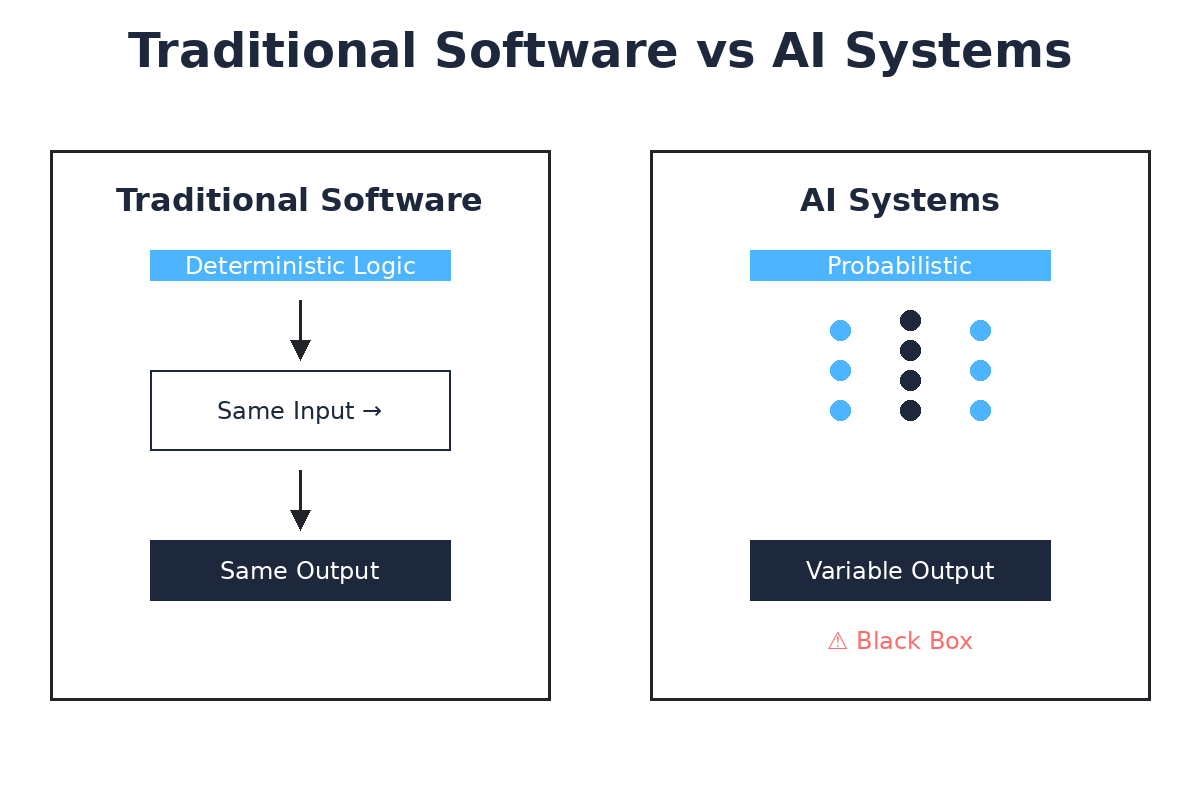
AI risk management differs fundamentally from traditional risk management because AI systems exhibit behaviours that conventional software does not. Traditional applications follow deterministic logic—the same input produces the same output every time. AI models, particularly machine learning systems, make probabilistic predictions that can change as they learn from new data.
This non-deterministic nature creates three foundational challenges. First, AI systems can produce unexpected outputs that violate business rules or ethical standards even when functioning as designed. Second, these systems often operate as “black boxes,” where the decision-making process remains opaque to users and auditors. Third, AI models degrade over time as real-world conditions drift from their training data, requiring ongoing monitoring that traditional software doesn’t need.
These characteristics mean organisations cannot simply extend existing IT risk frameworks to AI. They need dedicated approaches that account for algorithmic uncertainty, data dependencies, and the sociotechnical complexity of AI deployments.
The Core Categories of AI Risk
Technical Risks
Technical AI risks emerge from how models are built, trained, and deployed. Model accuracy represents the most obvious concern—systems that make incorrect predictions can damage customer relationships, waste resources, or create safety hazards. In healthcare diagnostics, financial fraud detection, or autonomous vehicles, prediction errors carry direct consequences.
Model drift occurs when the statistical properties of real-world data diverge from training data, causing performance degradation over time. A credit scoring model trained on pre-pandemic economic patterns might make unreliable predictions in changed market conditions without retraining.
Adversarial attacks exploit model vulnerabilities through carefully crafted inputs designed to fool AI systems. Researchers have demonstrated that adding imperceptible noise to images can cause object recognition systems to misclassify stop signs as speed limit signs—a technique with obvious implications for autonomous vehicle safety.
Data quality and availability risks stem from AI systems’ fundamental dependence on training data. Incomplete, outdated, or unrepresentative datasets produce models that fail when deployed. Many organizations discover too late that their production data differs significantly from their training data.
Ethical and Bias Risks
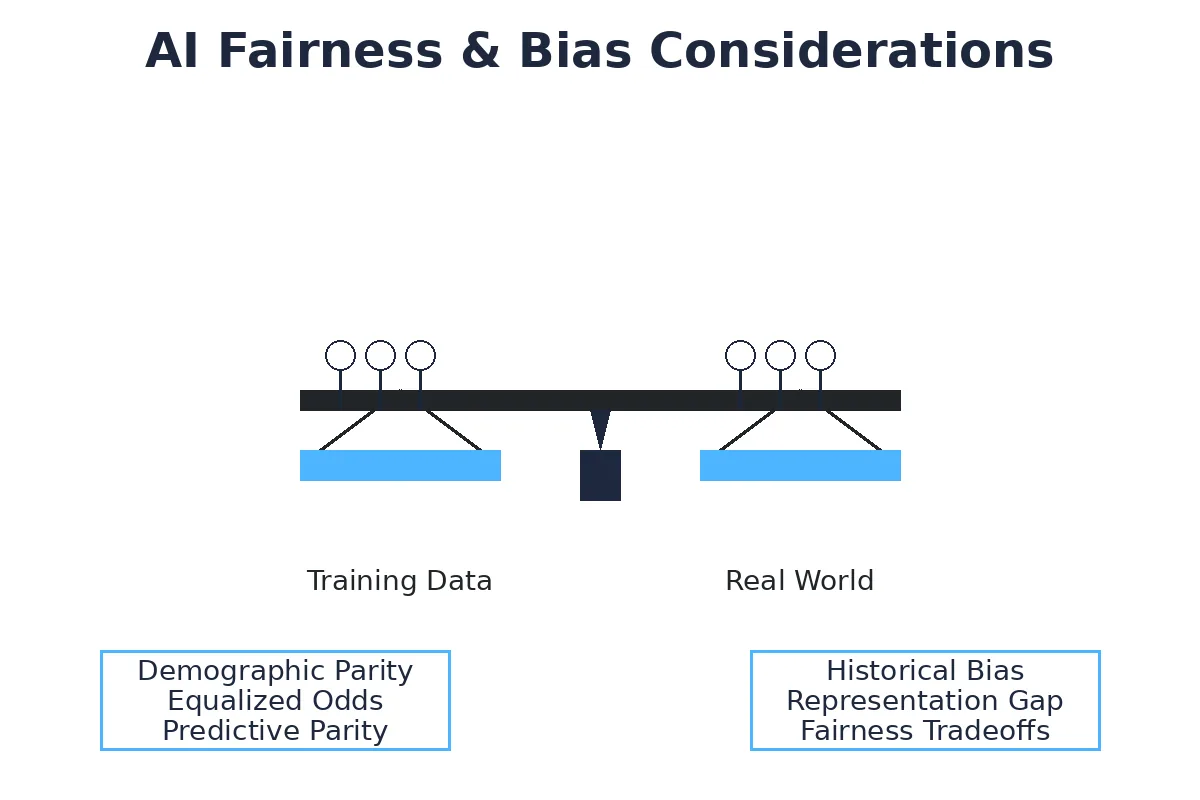
AI systems can perpetuate and amplify existing societal biases when trained on historical data that reflects past discrimination. A hiring algorithm trained on résumés from a male-dominated industry may learn to favor male candidates. A facial recognition system trained predominantly on lighter-skinned faces performs less accurately on darker-skinned individuals.
These bias issues extend beyond protected characteristics. AI systems can discriminate based on geographic location, education access, digital literacy, or other factors that correlate with disadvantaged groups. The challenge intensifies because bias can emerge from multiple sources: training data, feature selection, algorithm design, or deployment context.
Fairness in AI remains a contested technical and philosophical challenge. Different fairness definitions—demographic parity, equalized odds, predictive parity—often conflict mathematically. An AI system cannot simultaneously satisfy all fairness criteria, forcing organizations to make explicit value judgments about acceptable tradeoffs.
Compliance and Regulatory Risks
The regulatory landscape for AI shifted dramatically in recent years. The European Union’s AI Act establishes risk-based requirements for AI systems operating in the EU market, with the strictest controls on “high-risk” applications in areas like employment, credit scoring, law enforcement, and critical infrastructure.[Source: EU AI Act, Official Journal of the European Union]
In the United States, sector-specific regulations increasingly address AI. Financial services face scrutiny from regulators expecting model risk management frameworks. Healthcare AI must navigate FDA oversight for medical devices and HIPAA requirements for patient data. The Federal Trade Commission has signalled enforcement intentions around AI-powered discrimination and deceptive practices.
Organisations operating internationally must navigate fragmented requirements. What’s permissible under U.S. law may violate GDPR in Europe or China’s Personal Information Protection Law. This regulatory complexity makes compliance risk management essential for AI systems with cross-border implications.
The AI Risk Management Lifecycle
Risk Identification and Assessment
Effective AI risk management begins before model development. Organizations must evaluate whether AI is appropriate for a given use case, considering the cost of errors, availability of quality training data, and feasibility of adequate oversight.
Risk assessment for AI requires evaluating both inherent risks (what could go wrong) and residual risks (what remains after controls). This assessment considers the AI system’s intended use, affected stakeholders, data characteristics, model architecture, deployment environment, and potential for harm.
Organizations should document risk tolerance thresholds explicitly. What prediction accuracy is acceptable? What level of bias is tolerable? How much model drift triggers retraining? Clear thresholds enable consistent decision-making and provide audit trails.
Risk Mitigation Strategies
Technical controls for AI risk include diverse approaches across the system lifecycle. During development, techniques like bias testing on demographic subgroups, adversarial robustness testing, and explainability analysis help identify issues before deployment.
Governance controls establish accountability structures, approval workflows, and documentation requirements. An AI review board with cross-functional representation can evaluate high-risk AI initiatives before deployment. Clear role definitions prevent the diffusion of responsibility that allows risky AI systems to reach production.
Process controls embed risk considerations into workflows. Requiring algorithmic impact assessments for customer-facing AI, mandating human review of high-stakes automated decisions, and establishing model retraining schedules create systematic risk reduction. Monitoring and alerting systems detect degradation, drift, and anomalies in production AI systems. These technical controls should trigger human review when performance metrics fall below thresholds or when the system encounters edge cases outside its training distribution.
Continuous Monitoring and Adaptation
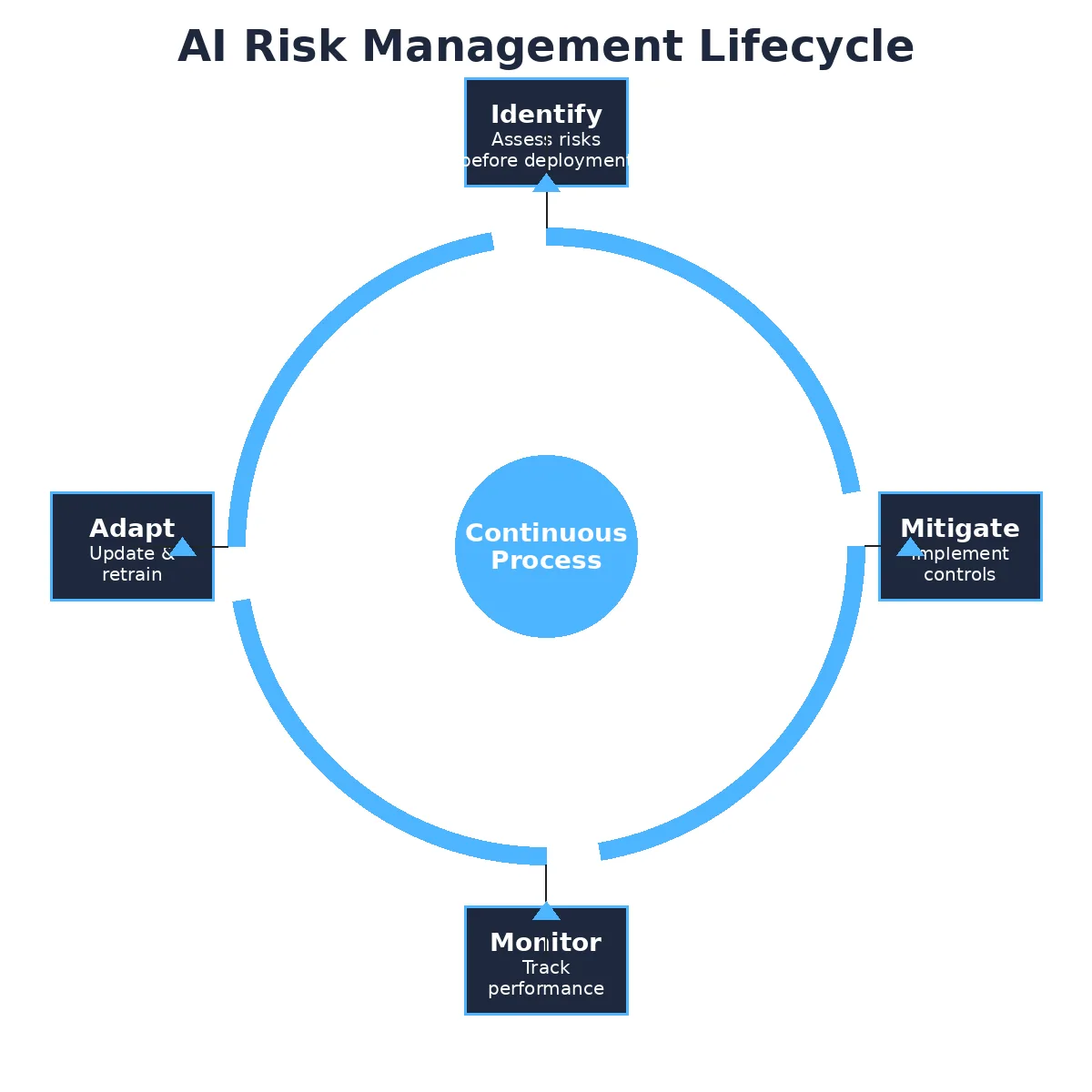
AI risk management is not a one-time exercise. Models require ongoing performance monitoring, periodic retraining, and regular audits to maintain effectiveness and compliance. Performance monitoring tracks prediction accuracy, fairness metrics, system uptime, and resource utilisation. Dashboards should provide visibility to both technical teams and business stakeholders, enabling rapid response to degradation.
Drift detection algorithms compare current input distributions to training data distributions, alerting teams when real-world data shifts significantly. Some organisations implement automated retraining pipelines triggered by drift detection, though human oversight remains essential for high-stakes systems.
Periodic audits by internal teams or third parties verify that deployed AI systems continue meeting risk management standards. These audits should examine model documentation, test results, fairness evaluations, security controls, and incident response procedures.
Key Frameworks and Standards
NIST AI Risk Management Framework
The U.S. National Institute of Standards and Technology published its AI Risk Management Framework to provide organisations with a voluntary, adaptable approach to AI risk management. The framework organises activities into four functions: govern, map, measure, and manage.
[Source: NIST AI Risk Management Framework 1.0]
The Governance function establishes organisational structures, policies, and culture for responsible AI. Map activities identify AI risks in context, considering stakeholders, impacts, and potential harms. Measure functions, and assess identified risks using appropriate tools and metrics. Manage activities,, implement risk treatment strategies, and track effectiveness.
This framework intentionally avoids prescriptive requirements, recognizing that appropriate risk management varies by organisation size, sector, and risk appetite. It provides a common vocabulary and structured approach without mandating specific technical solutions.ISO/IEC Standards
ISO/IEC 42001
If you’re looking for international certification, ISO/IEC 42001 provides a management system standard specifically for AI.
Published in December 2023, this standard helps you:
- Establish systematic controls over AI development and deployment
- Demonstrate compliance with AI regulations
- Build stakeholder trust through independent certification
- Integrate AI governance with existing ISO management systems (like ISO 27001 for information security)
Organisations pursuing ISO 42001 certification benefit from structured documentation requirements, regular audits, and continuous improvement processes that keep AI governance from becoming stale.
EU AI Act Requirements
The EU AI Act, which begins enforcement in 2026, takes a risk-based regulatory approach that categorizes AI systems by their potential for harm.
You need to understand these categories:
- Unacceptable risk: Prohibited AI systems (social scoring by governments, certain real-time biometric identification)
- High risk: Strict compliance requirements including conformity assessments, documentation, human oversight, and accuracy thresholds
- Limited risk: Transparency obligations (users must know they’re interacting with AI)
- Minimal risk: No specific requirements, though general laws still apply
High-risk AI systems face the most stringent requirements: risk management systems, data governance, technical documentation, record-keeping, transparency, human oversight, accuracy requirements, robustness, and cybersecurity measures.
Non-compliance carries steep penalties—up to €35 million or 7% of global annual turnover for prohibited AI, and up to €15 million or 3% for other violations.
Industry-Specific Frameworks
Financial services organisations often reference model risk management guidance from banking regulators, which predates modern AI but establishes relevant principles around validation, testing, and governance. Healthcare AI developers must navigate FDA guidance on software as a medical device, which incorporates risk-based classifications. Organisations should evaluate which frameworks align with their industry, regulatory environment, and organizational maturity. Many successful programs integrate multiple frameworks rather than rigidly following a single standard.
Building Your AI Risk Management Program
Framework knowledge means nothing without execution. Here’s how to build an effective AI risk management program your organization will actually use.
Step 1: Establish Governance Structure
You need clear accountability before anything else works. Who owns AI risk in your organization?
Create these roles and responsibilities:
- AI Governance Board: Senior leadership providing strategic direction and risk appetite
- Chief AI Officer (or equivalent): Executive responsible for AI strategy and risk oversight
- AI Risk Manager: Day-to-day risk identification, assessment, and mitigation
- Model Validators: Independent review of AI systems before deployment
- Ethics Committee: Evaluation of ethical implications and societal impact
Document decision rights, escalation paths, and approval authorities. Ambiguity in governance creates gaps where risks slip through.
Step 2: Inventory Your AI Systems
You can’t manage risks you don’t know about. Conduct a comprehensive AI inventory across your organisation.
Catalogue each system’s:
- Purpose and business function
- Development approach (built internally, purchased, open source)
- Data sources and types
- Decision authority (automated vs. human-in-the-loop)
- User population and impact
- Current lifecycle stage (development, deployed, retired)
Many organizations discover AI systems they didn’t know existed—shadow AI deployed by departments without IT oversight. Your inventory process must catch these.
Step 3: Implement Risk Assessment Process
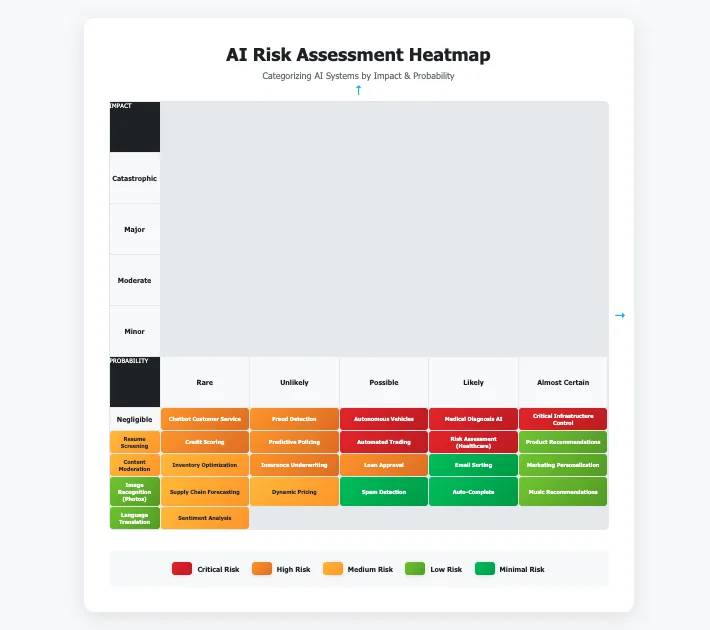
Not all AI systems carry equal risk. You need a repeatable assessment process that prioritises where to focus resources.
Evaluate each system across these dimensions:
Impact: What happens if this AI system fails or produces wrong results? Complexity: How difficult is the model to understand, validate, and maintain? Autonomy: Does AI make final decisions or just recommendations? Scope: How many people and processes does this AI affect? Regulatory sensitivity: Does this system fall under specific compliance requirements? Data sensitivity: What types of data does the system process?
Use a standardised scoring methodology (like 1-5 scales for each dimension) to calculate overall risk ratings. High-risk systems require more rigorous controls, frequent monitoring, and senior leadership oversight.
Step 4: Design Control Framework
For each identified risk, implement appropriate controls following defense-in-depth principles.
- Preventive controls: Stop risks before they occur (input validation, access restrictions, bias testing in development)
- Detective controls: Identify when risks materialise (continuous monitoring, anomaly detection, audit logging)
- Corrective controls: Fix issues after they occur (incident response, model retraining, rollback procedures)
Document each control’s purpose, implementation details, responsible party, testing frequency, and evidence requirements. Vague controls like “ensure AI fairness” don’t work—you need specific, measurable actions.
Step 5: Establish Monitoring and Testing
AI systems drift over time. What performed well at deployment might degrade as conditions change.
Implement continuous monitoring for:
- Model performance: Track accuracy, precision, recall, and other relevant metrics
- Data quality: Monitor for distribution shifts, missing values, and anomalies
- Fairness metrics: Check for emerging bias across demographic groups
- System availability: Ensure reliability and response times meet requirements
- Security events: Watch for adversarial attacks or unusual access patterns
Set clear thresholds that trigger alerts and define escalation procedures when monitoring detects issues. Automated dashboards help, but you need humans who understand what the metrics mean and can take action.
Step 6: Build Incident Response Capability
When AI failures happen—and they will—you need clear processes to contain damage and restore operations.
Your AI incident response plan should cover:
- Classification criteria (what qualifies as an AI incident?)
- Notification requirements (who needs to know, how quickly?)
- Investigation procedures (how to determine root cause?)
- Containment actions (can we roll back to previous model version?)
- Remediation steps (fixing underlying issues, not just symptoms)
- Communication protocols (internal, customer, regulatory)
- Lessons learned process (preventing recurrence)
Test your incident response through tabletop exercises. Theory sounds great until you’re actually dealing with an AI system making discriminatory decisions that violated civil rights laws—then you discover all the gaps in your plan.
Building Organizational Capability
AI risk management requires capabilities that many organisations lack initially. Training programs should educate data scientists on responsible AI practices, teach business leaders to ask appropriate risk questions, and help compliance professionals understand AI-specific challenges.
Many organisations establish centres of excellence or internal consulting teams that provide AI risk management expertise to project teams. These centralised resources develop reusable tools, templates, and guidance while building organisational knowledge.
External expertise through consultants, auditors, or advisory boards can supplement internal capabilities, particularly during program establishment or for specialised assessments of high-risk systems.
Common Challenges and Solutions
Organisations implementing AI risk management consistently encounter several obstacles. Technical teams sometimes resist risk management processes as bureaucratic impediments to innovation. Business pressure to deploy AI quickly conflicts with thorough risk assessment. Limited understanding of AI among risk and compliance professionals creates communication gaps.
Successful programs address these challenges through executive sponsorship that balances innovation with responsibility, streamlined risk processes integrated into existing workflows rather than separate gates, and ongoing education that builds AI literacy across functions.
Starting with pilot programs on moderate-risk AI systems allows organisations to refine their approach before tackling enterprise-wide implementation. Quick wins that prevent issues demonstrate value and build support for broader programs.
Measuring AI Risk Management Program Effectiveness
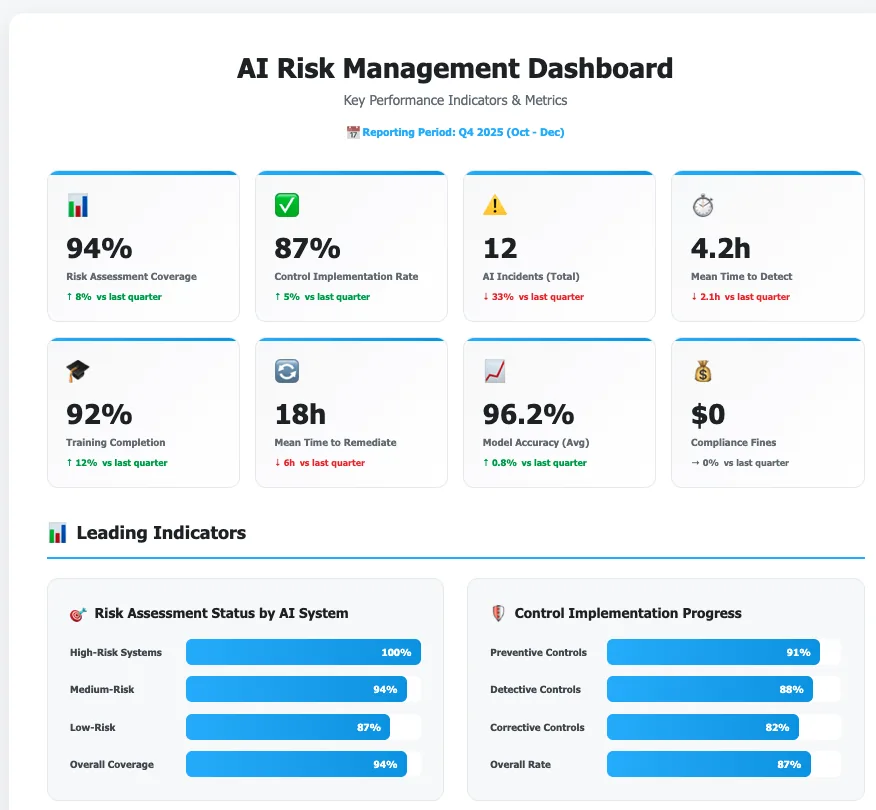
You need metrics proving your AI risk management program actually works, not just exists on paper.
Leading Indicators
These metrics predict future problems:
- Risk assessment coverage: Percentage of AI systems with current risk assessments
- Control implementation rate: Identified risks with documented controls in place
- Training completion: Personnel with required AI risk management training
- Testing frequency: How often you validate controls and model performance
- Time to risk assessment: Days from AI system proposal to completed risk review
Lagging Indicators
These metrics show outcomes:
- Incident frequency: Number of AI-related incidents (by severity)
- Time to detect: How quickly you identify AI failures or drift
- Time to remediate: How fast you fix issues once detected
- Regulatory findings: Issues identified during audits or examinations
- Model performance: Accuracy, fairness, and reliability metrics over time
Business Impact Metrics
Connect AI risk management to business outcomes:
- Cost avoided through prevented incidents
- Revenue protected by maintaining AI system reliability
- Customer trust metrics for AI-powered services
- Compliance cost reduction through proactive management
- Time-to-market for AI initiatives with proper risk controls
Don’t just count activities (we conducted 47 risk assessments!). Show how your program reduces actual harm and enables safer AI innovation.
Getting Started with AI Risk Management
Ready to begin? Here’s your practical action plan.
First 30 Days
- Inventory all AI systems currently deployed or in development
- Conduct preliminary risk assessment of highest-impact AI applications
- Identify key stakeholders and establish governance structure
- Review applicable regulations and framework requirements
- Document current state of AI risk management (or lack thereof)
First 90 Days
- Develop AI risk management policy defining your approach
- Implement risk assessment process for all AI systems
- Design control framework addressing priority risks
- Establish monitoring and testing procedures
- Create AI incident response plan
- Begin training programs for relevant personnel
First Year
- Complete risk assessments across the entire AI portfolio
- Implement controls for high- and medium-risk systems
- Establish metrics and reporting to leadership
- Conduct the first full cycle of monitoring and control testing
- Update program based on lessons learned
- Plan for independent validation or audit
The Future of AI Risk Management
AI risk management continues evolving as technology advances and regulatory expectations mature. Generative AI introduces new risk categories around content authenticity, intellectual property, and misinformation that existing frameworks only partially address. Autonomous systems raise questions about liability and human oversight that legal frameworks are still working through.
Organisations building AI risk management capabilities now position themselves advantageously. As regulatory requirements solidify and customer expectations rise, mature risk management programs become competitive differentiators rather than compliance checkboxes.
The most effective approach treats AI risk management not as a constraint on innovation but as an enabler. By systematically addressing risks, organisations can deploy AI with confidence, achieve stakeholder trust, and unlock AI’s value while avoiding the pitfalls that derail less disciplined efforts.
Frequently asked questions
What are the main risks of artificial intelligence?
The main AI risks span technical failures like inaccurate predictions and model drift, ethical concerns including algorithmic bias and fairness issues, regulatory compliance challenges from evolving laws, security vulnerabilities to adversarial attacks, and operational risks from system dependencies. Each category requires specific mitigation strategies within a comprehensive risk management framework.
How is AI risk different from traditional IT risk?
AI risk differs from traditional IT risk because AI systems make probabilistic rather than deterministic decisions, operate as black boxes with limited explainability, degrade over time through model drift, depend critically on training data quality, and raise unique ethical concerns around bias and fairness that conventional software doesn't present.
Who is responsible for AI risk management in an organisation?
AI risk management responsibility typically spans multiple roles: executives provide governance and accountability, data scientists implement technical controls, compliance officers ensure regulatory alignment, legal teams address liability concerns, and business units own use case appropriateness. Cross-functional collaboration through an AI governance board ensures coordinated oversight.
What is the NIST AI Risk Management Framework?
The NIST AI Risk Management Framework is a voluntary guidance document organizing AI risk management into four functions: Govern (establish structures and culture), Map (identify context and risks), Measure (assess risks with appropriate tools), and Manage (implement treatment strategies). It provides flexible, adaptable practices rather than prescriptive requirements.
Do small companies need AI risk management?
Small companies using AI need risk management proportionate to their AI systems' potential impact. While resource constraints may limit formal programs, basic practices like documenting AI use cases, testing for bias, monitoring performance, and establishing human oversight create meaningful risk reduction without extensive infrastructure.

About the author
Patrick Dasoberi
Founder and CEO of Freedom Protocol and former CTO of CarePoint (formerly African Health Holding), where he was responsible for healthcare systems across Ghana, Nigeria, Kenya and Egypt and now works as an independent contractor. Writes about securing AI systems under African and global regulation.
Full background