The Problem Nobody’s Talking About
I’ve sat through dozens of AI product demos over the past three years. Brilliant engineers showcasing impressive machine learning models, sophisticated algorithms, and cutting-edge capabilities. Then I ask a simple question: “How are you handling adversarial attacks on your training data?” Silence. Or my personal favourite: “What’s your compliance framework for processing personal data through this AI system under Ghana’s Data Protection Act 843?”
Here’s what I learned as CTO managing healthcare systems across Ghana, Nigeria, Kenya, and Egypt—and now operating AI-powered platforms across Ghana, Nigeria, and South Africa: The AI industry has a dangerous blind spot.
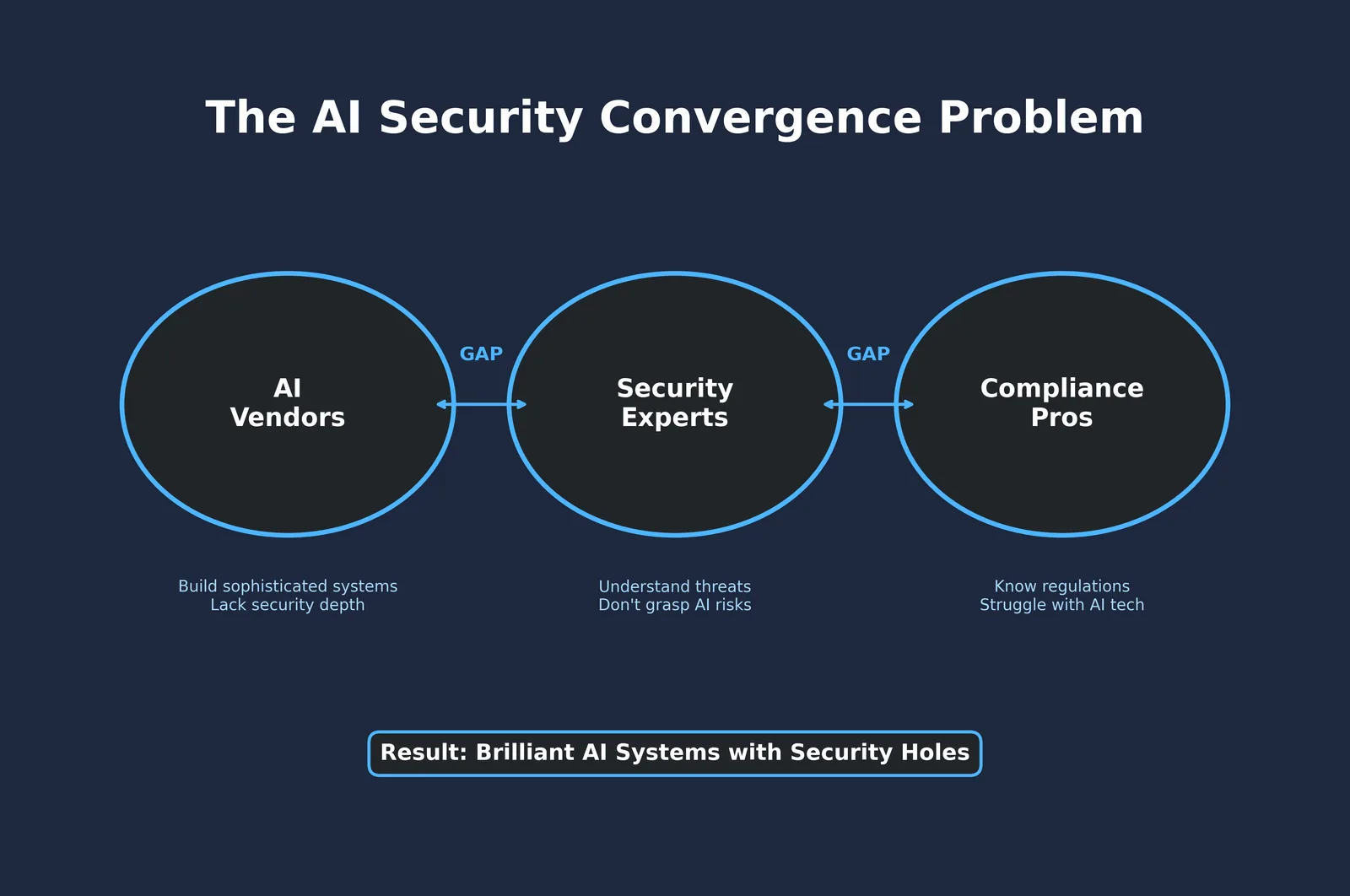
Vendors excel at building sophisticated AI systems but lack depth in cybersecurity and compliance. Security professionals understand threats but don’t grasp AI-specific vulnerabilities. Compliance experts know regulations but struggle with AI’s technical implications.
Nobody teaches all three together. University courses separate them. Certifications silo them. The market forces you to learn them independently, then somehow figure out how they intersect.
This creates systems with brilliant AI—and gaping security holes.
I’ve seen it firsthand—both as CTO responsible for multi-country healthcare systems and operating current AI platforms. AI models trained on poisoned data. Patient information exposed through model inversion attacks. Systems that violate GDPR and don’t even know it. Healthcare AI deployed without business associate agreements. Brilliant technology. Terrible security. Worse compliance.
This is why I built AI Security Info: to bring these three critical areas together in a way that makes sense for practitioners building real systems.
Why This Convergence Matters Now
The market is heading toward a reality where AI, cybersecurity, and compliance aren’t separate disciplines—they’re inseparable requirements. Consider what’s happening:
Regulatory Pressure is Intensifying
The EU AI Act mandates specific security requirements for high-risk AIGhana’s Data Protection Commission is scrutinizing AI data processingHIPAA enforcers are asking hard questions about AI in healthcare Every major jurisdiction is developing AI-specific regulations You can’t build compliant AI without understanding both the technology AND the regulatory frameworks.
AI-Specific Threats Are Evolving
- Adversarial attacks manipulate model behavior
- Training data poisoning compromises model integrity
- Model extraction steals intellectual property
- Membership inference reveals private training data Traditional cybersecurity tools don’t detect these attacks. You need AI-aware security approaches.
Business Risk is Escalating
- AI failures make headlines (and courtrooms)
- Regulators are issuing substantial fines
- Customer trust depends on demonstrable security
- Insurance providers are asking about AI security controls Based on my experience operating healthcare AI platforms, the organisations that thrive will be those that master the convergence of AI capabilities, security resilience, and regulatory compliance. The ones that treat these as separate problems will fail—slowly through erosion of trust, or quickly through regulatory enforcement.
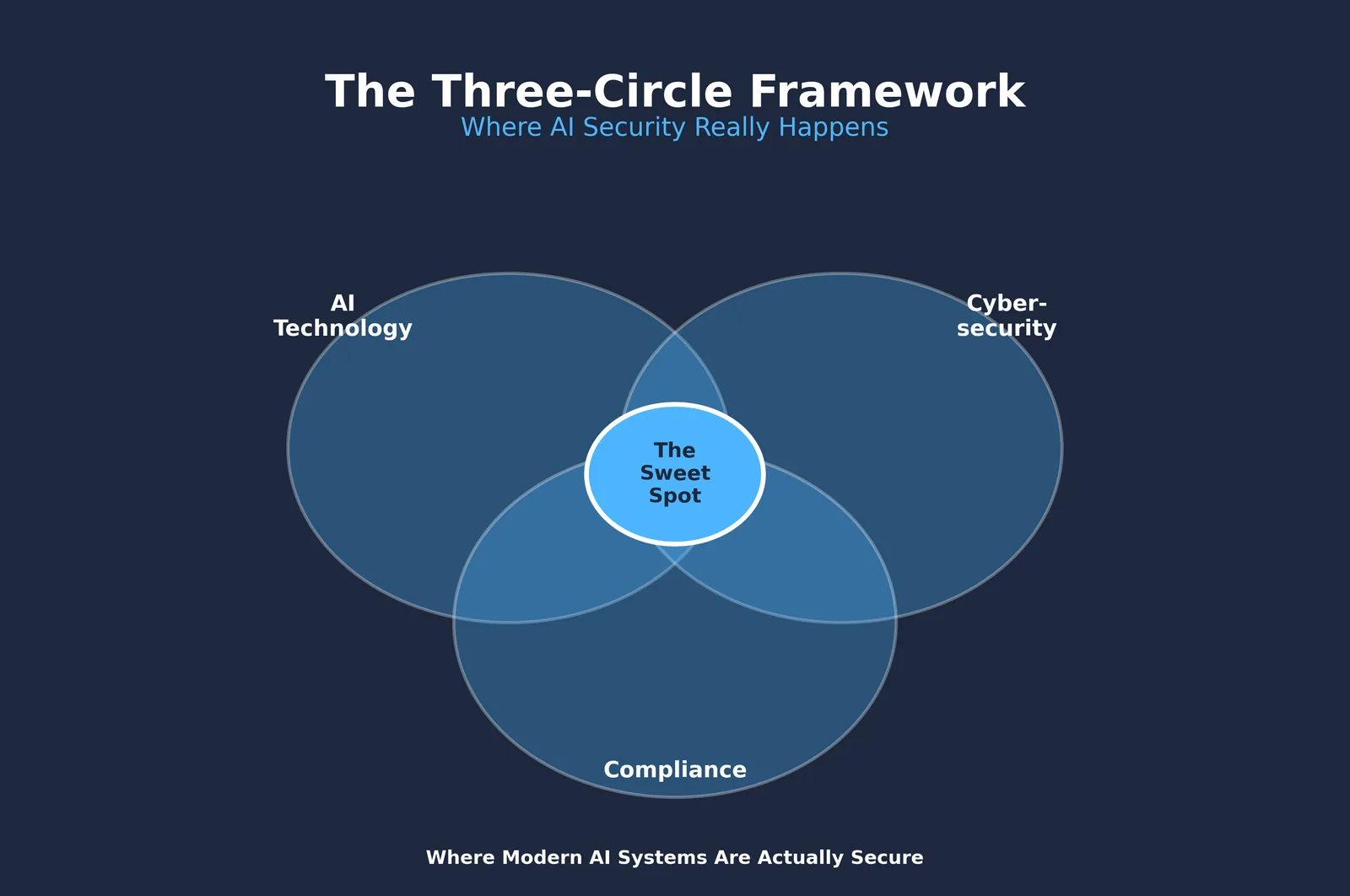
The Three-Circle Framework: Where AI Security Lives
Through my work at the intersection of AI development, information security auditing (CISA), and data privacy engineering (CDPSE), I’ve developed a framework for thinking about AI cybersecurity:

Circle 1: AI Technology Understanding
You must understand what AI actually IS before you can secure it. This isn’t about becoming a data scientist. It’s about understanding:
- How machine learning models learn from data
- What training data actually contains and reveals
- How models make predictions and decisions
- Where AI systems differ fundamentally from traditional software
Why this matters: You can’t secure what you don’t understand. When a vendor demos an AI system, you need to ask intelligent questions about model architecture, training methodology, data handling, and inference processes.
Real example: I once reviewed an AI diagnostic tool that claimed to be “fully secure.” When I asked about their training data provenance, they had no documentation. No chain of custody. No verification that patient data used for training had proper consent. Brilliant AI. Complete compliance disaster.
Circle 2: Cybersecurity Principles Applied to AI
Traditional security approaches don’t translate directly to AI systems.
Yes, you still need encryption, access controls, and network security. But AI introduces entirely new attack surfaces:
Data Security (Beyond Storage)
Training data integrity: Can attackers poison your training data? Inference data protection: Are user queries revealing sensitive information? Model outputs: Can responses be used to infer private training data?
Model Security (New Territory)
Adversarial robustness: How resilient is your model to manipulated inputs? Model extraction protection: Can attackers steal your model through API queries? Intellectual property: How do you protect your model architecture and weights?
Operational Security (Different Dynamics)
Continuous learning: If your model updates from production data, how do you prevent poisoning?A/B testing: Are you inadvertently exposing model vulnerabilities? Monitoring: What does “normal” look like for AI system behavior?
From my experience as CTO and current platform operations: We had to completely rethink our security monitoring for AI systems. Traditional SIEM alerts weren’t catching adversarial probing. We needed AI-aware security tools that understood model behavior patterns.
Circle 3: Compliance in the AI Era
AI complicates compliance in ways regulations didn’t anticipate.
Data Protection Regulations (GDPR, Ghana Act 843, CCPA)
Right to erasure: How do you delete training data from a learned model? Purpose limitation: Is using customer data to improve AI “compatible processing”?Transparency: Can you explain AI decision-making to data subjects?
Sector-Specific Regulations (HIPAA, FERPA)
PHI protection: Does your AI properly de-identify patient data? Business Associate Agreements: Do your AI vendors understand their obligations? Security Rule compliance: Are your AI systems meeting required safeguards?
AI-Specific Regulations (EU AI Act)
Risk classification: Is your AI system “high-risk” under regulatory definitions? Documentation requirements: Can you demonstrate model provenance and testing? Human oversight: Do you have appropriate human-in-the-loop controls?
Operating across three African countries taught me: Compliance isn’t just about following rules. It’s about understanding regulatory intent and building systems that respect fundamental rights—even when regulations don’t specifically mention AI.
The Sweet Spot: Where All Three Intersect
This is where real AI security happens. This is where I operate. This is what makes modern applications actually secure.
At this intersection, you can:
- Build AI systems that are technically sophisticated AND secure
- Meet regulatory requirements without sacrificing functionality
- Implement security controls that align with compliance obligations
- Understand risks from technical, security, AND legal perspectives
- Make informed decisions about AI deployment
Without this convergence: You build impressive systems that can’t be deployed safely or legally.
The Common Mistakes I See
Through reviewing AI systems and talking with vendors, I see the same mistakes repeatedly:
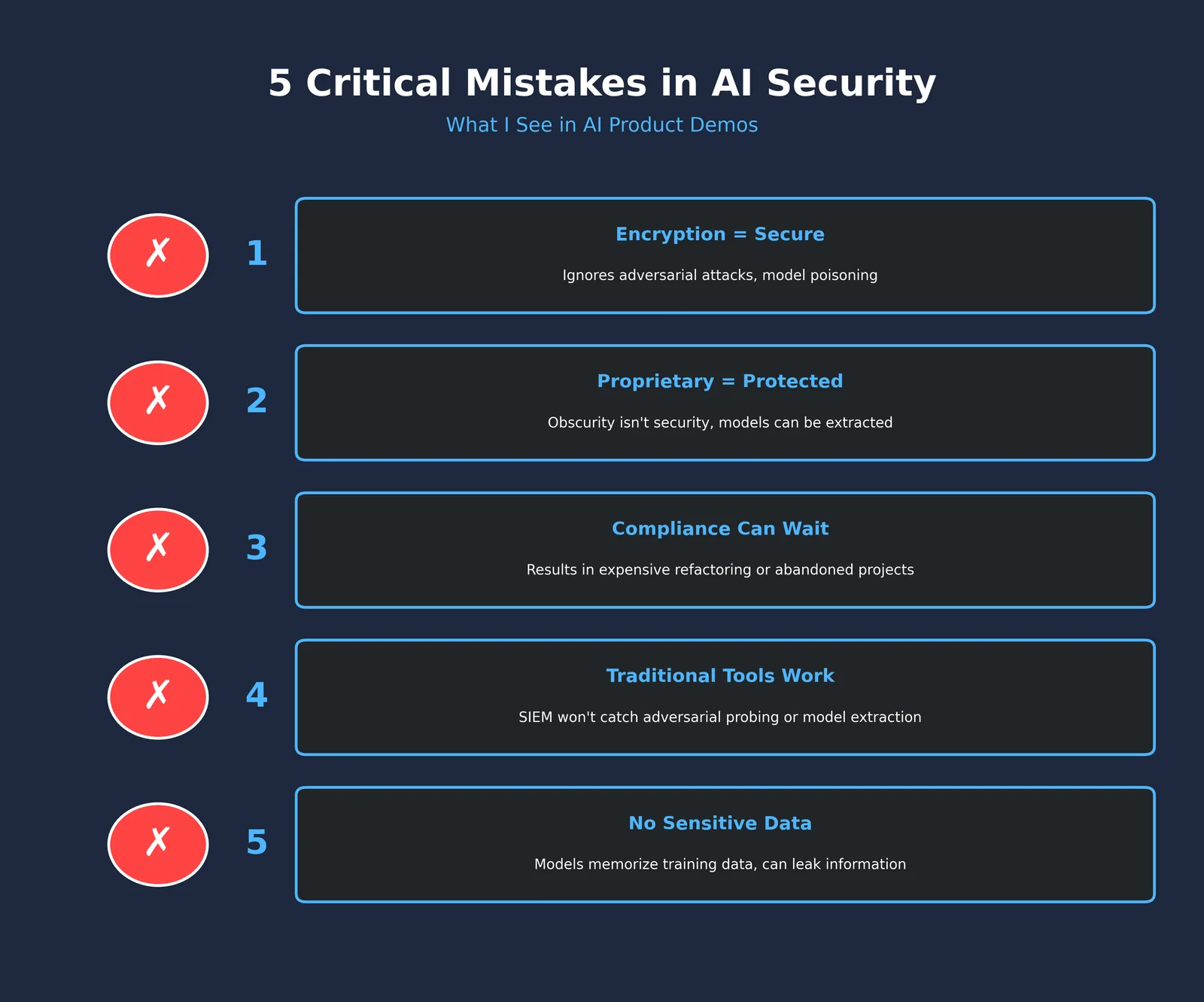
Mistake 1: “We’re Using Encryption, So We’re Secure”
Encryption protects data at rest and in transit. It does nothing for:
- Adversarial attacks manipulating model behavior
- Training data poisoning
- Model extraction through API abuse
- Inference-time privacy leaks
Better approach: Layer security controls specific to AI threats on top of traditional security.
Mistake 2: “Our Model is Proprietary, So It’s Protected”
Obscurity isn’t security. Attackers can:
- Extract model functionality through systematic querying
- Reverse engineer model architecture from behavior
- Steal model weights from insecure storage
Better approach: Assume attackers understand your model architecture. Implement actual protection mechanisms.
Mistake 3: “We’ll Handle Compliance Later”
By the time you’re ready to deploy, “later” means expensive refactoring or abandoning the project.
Real example: I reviewed an AI diagnostic tool that would require complete re-architecture to comply with HIPAA. Millions invested. Can’t legally deploy. It could have been designed right from day one.
Better approach: Integrate compliance requirements into AI system design from the start.
Mistake 4: “Traditional Security Tools Work Fine for AI”
Your SIEM won’t catch adversarial probing. Your firewall won’t stop model extraction. Your vulnerability scanner doesn’t understand AI-specific weaknesses.
Better approach: Augment traditional security with AI-aware tools and processes.
Mistake 5: “We Don’t Process Sensitive Data”
Your AI model might not process sensitive data directly, but:
- Training data might have contained sensitive information
- Model can memorize and leak training data
- Inference patterns might reveal sensitive insights
- Aggregated outputs might enable re-identification
Better approach: Assume AI processing has privacy implications and implement appropriate controls.
Articles in this pillar
- Top 7 AI Security Threats in 2026: The Complete GuideUpdated April 2026
- AI Agent Security Risks: The Enterprise Guide to Autonomous Threat ProtectionUpdated January 2026
- How to Land Your First AI Security Job (No Experience Required)Updated December 2025
- AI Cybersecurity for Beginners: Your Essential GuideUpdated December 2025
- What Is AI in Cybersecurity? The Complete 2026 GuideUpdated December 2025